
Episode 16: Sex Testing in Sports: Bias & the Science of Genetic Variation
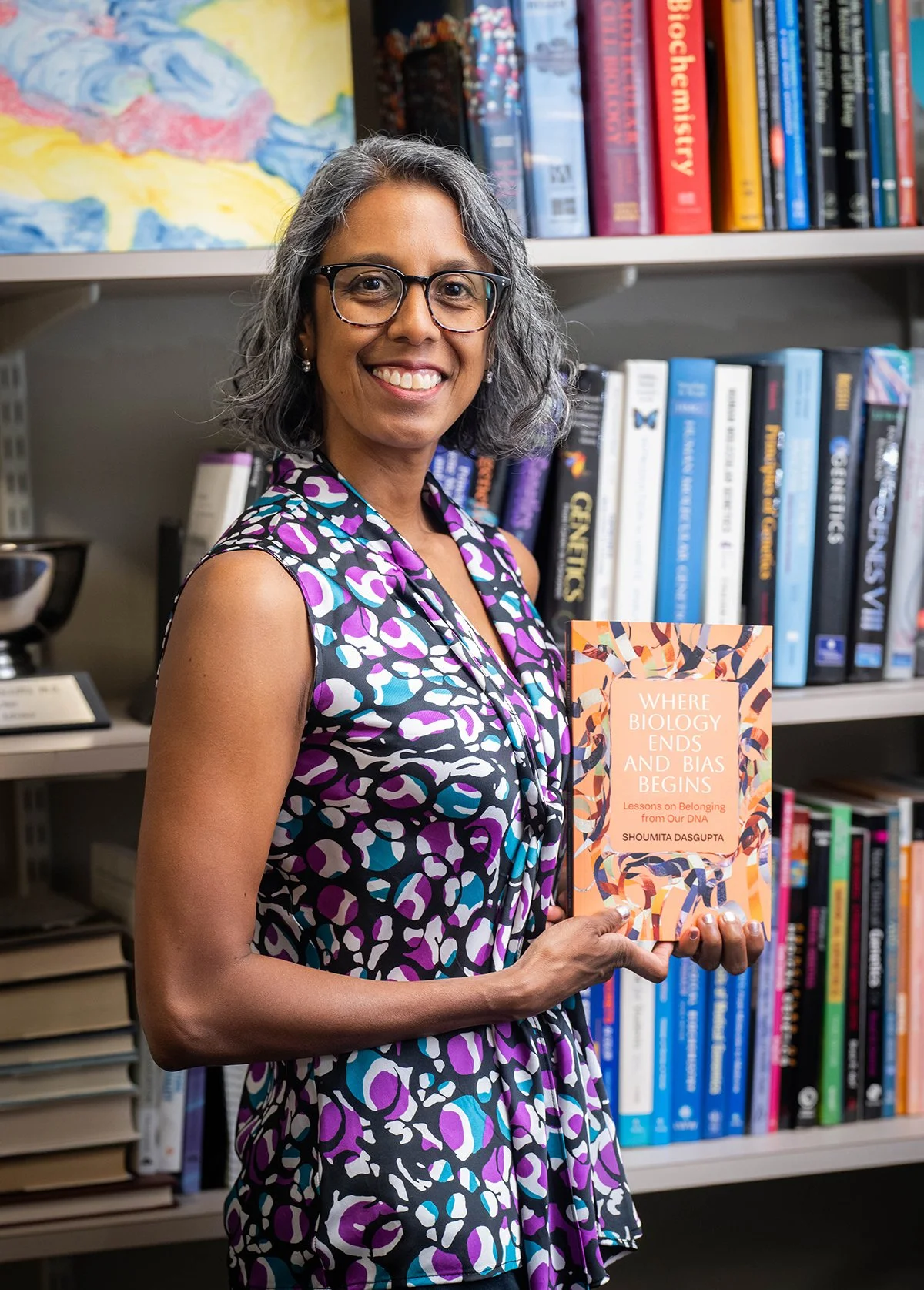
Shoumita Dasgupta, PhD
Guest
Shoumita Dasgupta, PhD, Professor of Medicine and Assistant Dean for Diversity and Inclusion at Boston University. A geneticist by training, Professor Dasgupta is an internationally recognized anti-racism educator and the author of Where Biology Ends and Bias Begins: Lessons on Belonging from Our DNA.
TRANSCRIPT
Hi everyone. This is Genetic Frontiers. A podcast about the promise, power and perils of genetic information find us wherever podcasts are found and go to geneticfrontiers.org to join the conversation about how genetic discoveries are propelling new personalized medical treatments, but also posing ethical dilemmas and emotional quandaries. I'm your host, Susanna Smith.
On today's episode, I will be talking with Shoumita Dasgupta, PhD, who is a Professor of Medicine and Assistant Dean for Diversity and Inclusion at Boston University. Professor Dasgupta is a geneticist by training, and she is an internationally recognized anti-racism educator and the author of a new book, Where Biology Ends and Bias Begins: Lessons on Belonging from Our DNA.
In this book, Professor Dasgupta tackles a number of really big subjects, including the relationships we derive between our DNA and aspects of our identity, such as our race or ethnicity, our sex, gender, or sexual orientation and our understandings of genetic difference and disability. She digs into what is actually known about the inner workings of our bodies and our genetics versus the stories we, as humans, have created to make meaning of our DNA for ourselves. Many of the stories we tell ourselves are detached from the realities of what scientists have learned about human biology. Often these stories are laced with bias and grounded consciously or subconsciously in the idea that human beings can be categorized, organized, understood, and assigned value based on aspects of our biology. It's an overly simplistic idea, but it's foundational to how the United States was built, and how this country and many others continue to operate.
What scientists have found over the last century is that human biology exists on a wide spectrum of diversity, plurality, and complexity that we are only now beginning to understand. Human beings aren't easily categorized or understood through their DNA. What Professor Dasgupta offers in Where Biology Ends and Bias Begins is a guide and a challenge to everyone who wants to dig into how our understanding—and misunderstandings—about human genetics shape how we see ourselves and other people.
Thank you, Professor Dasgupta, for joining me today on Genetic Frontiers.
Shoumita Dasgupta
Thank you so much, Susanna. It's my pleasure to be here with you today.
Susanna Smith
So I want to start with a topic that is very much in the news and the political crossfire today, and has been a hot-button topic in the United States for a long time, which is transgender athletes in women's sports.
In your book, you give a bit of history about how, before genetic testing, women athletes were made to parade themselves, their bodies were certain of their femaleness by viewing, and then only after were they allowed to compete in women's sports. Then in the early to mid-1980s, various forms of chromosomal analysis started to be used in athletics, and in some cases turned out unexpected results. And in the book, you write about a particular athlete, Maria José Martínez Patiño, who was the Spanish national champion in hurdles in the 1980s, and went on to compete internationally.
Could you share a bit of Maria's story with our listeners?
RESOURCES
Rebecca Schneid. “How the Olympic Ban on Transgender Women Could Affect All Women Athletes.” TIME. April 5, 2026.
María José Martínez-Patiño. “A Woman Tried and Tested.” The Lancet. 2005;366:S38.
Statement by UN Women on discrimination against female athletes. May 2019.
Sport & Rights Alliance et al. Statement: International Olympic Committee has no right to become ‘gender police’ of the world. March 17, 2026.
Human Genetic Society of Australia. Position Statement: Mandatory SRY Gene Testing in Athletes Competing in the Female Category. August 2025.
ACLU. “Supreme Court Concludes Oral Arguments in Historic Transgender Rights Hearing.” Jan. 13, 2026 press release.
HRW. “Global: Caster Semenya’s Court Victory a Win for All Athletes,” July 25, 2025 news release.
Shoumita Dasgupta. “Behavioural genetics must prioritize communication,” Nature. 2026;10: 643-646.
Shoumita Dasgupta, PhD. Where Biology Ends and Bias Begins: Lessons on Belonging from Our DNA. University of California Press. 2025.
National Academies of Science, Engineering, and Medicine. Newborn Screening in the United States: A Vision for Sustaining and Advancing Excellence. Washington, DC: National Academies Press; 2025.
Shoumita Dasgupta
Absolutely, I'd be delighted to. Maria José Martínez Patiño was a track and field athlete. And when she was competing, there were a variety of different sex-based tests that they did to determine eligibility of athletes. And so, in this testing, there was really a major conflation between sex and gender, so it's somewhat helpful to understand the difference between the two. Sex has to do with the biology of one's body. You know, what's in your DNA? What organs do you have? What sex hormones are circulating through your system? And it turns out that sex is typically assigned at birth, based entirely on external anatomy. So, this particular way of determining sex just really doesn't kind of capture the overall complexity of the spectrum of sex, and the fact that sex is not binary, it's not simply male or female, but there are many, many intersex people on the planet as well. Then there's gender. And gender has to do more with, you know, who you identify with in your heart and in your mind. Do you feel like a boy, a girl, a man, a woman, a mix, or none of the above? That has to do with what gender is. And sexual orientation is an entirely different category, which has to do with who you are attracted to and who you love.
Now, in sport, there's a real fixation on binary categorization. The competitive categories tend to be men's sport and women's sport, which are gender designations, but the idea behind it is that there may be biological advantage to having been exposed to certain sex hormones, for instance, during development. So that's really to do with sex, not gender.
When Maria José Martínez Patiño was competing, she had to go through these sex tests, many of which were focused on her chromosomal makeup. So what tends to typically happen is that males typically have XY chromosomes, and females typically have XX chromosomes. When she was first competing, she passed these tests and was given a certificate of femininity, as it was called at the time. But then when she went on to compete in a subsequent competition, she didn't have her certificate with her, so she had to go through a retest. The retest indicated that she did not have two X chromosomes, which is what the previous test had said. So her test had to be repeated.
And this was, you know, kind of humiliating, or at least it called a lot of attention to her, and so she faked an injury to just kind of be out of the limelight while all of this was happening. Once the results came back, it actually showed that she had XY chromosomes, which are more typically associated with male development. If we dig deeper, though, what we found in the case of her own health was that she had androgen insensitivity syndrome. What that refers to is testosterone, which is an androgen, requires different kinds of biological components to elicit a response in human development. She didn't have those components, so she was not responsive to any testosterone in her system, even though she had XY sex chromosomes. Because she was unresponsive to testosterone, her body developed in the typical female fashion. She developed breasts and a vagina, and she identified as a woman in terms of her gender. Probably, if you really think about it, she was likely at a disadvantage compared to other women in her competitive category, and that's because testosterone is present in females and males. So typical females will have the ability to respond to testosterone, whereas she did not. So you could say that she was at a disadvantage. Nevertheless, because she didn't pass this repeat testing, it turns out that she was disqualified from further participation. That disqualification led to her losing her scholarship, her housing in the athletes' residences, her fiancé, her life just was completely blown up. And she, you know, to her credit, really took this as a call to action to work on behalf of other athletes who have different sorts of intersex characteristics and to really to fight and advocate for people to be able to compete in sport, regardless of, you know, kind of not fitting into the typical categorizations.
Susanna Smith
So, I want to back up to something I understood from the book, which was that
Maria didn't have any questions about her sex or her gender when she walked into these competitions. And also just to clarify for our listeners, the testing Maria underwent to receive this certificate of femininity was applied to all female athletes, it wasn't because she was different. This was every female athlete underwent this testing. So could you just clarify that point? But also what did Maria know when she walked into these competitions?
Shoumita Dasgupta
That's a great question and a really important point. It's notable that they engaged in this sort of sex testing or gender testing, depending on their framing, only for women athletes. There's no similar process in place for men athletes. So this was already, you know, kind of a process that has misogyny baked into it. As you said, she didn't have any suspicion or reason to believe that she was anything other than a typical cisgender woman. These tests often will unearth facts about people's identity that they themselves were unaware of.
When I said that sex is often assigned at birth. That really means that a lot of differences or variations in sex development are not actually identified until later on. Sometimes that can happen at puberty. Sometimes that can happen in the context of sport testing. Sometimes that can happen when people are trying to have children. So in Maria's case, you're right, she didn't know at all that this result was potentially in the cards.
Susanna Smith
Yeah, and I think one important point to point out is sometimes that could never be identified, right? Like in Maria's case, it was identified because she was this elite athlete who had to undergo this testing or that's what the sport required. But there's a possibility you could walk through your entire life and not be aware that your chromosomes don't align with your sex identity or your gender.
Shoumita Dasgupta
That's absolutely true. Another thing that is maybe worth thinking about is how common these intersex identities actually are in the population. Some estimates I've read place this at about 1.7% of the population, which is roughly the same as the percent of people who are redheads. And we all know redheads, which means we all know intersex people as well.
Susanna SmithSo for someone who is not a geneticist like you are, or who doesn't necessarily have a science background, could you give us some examples of different forms of non-binary sex? The different ways that can exist like chromosomal and hormonal, and you kind of go through some of that in the book.
Shoumita Dasgupta
Sure, absolutely.
I like to try to think about three main aspects of sex. Chromosomal sex, to do with the presence or absence of X and Y chromosomes, then there's gonadal sex, which is, you know, the reproductive organs that also produce the sex hormones, the sex hormones then drive development of the body. And the body can include secondary sex characteristics that are visible externally. And that would be, like, development of breasts, vagina, penis, other kinds of anatomy along those lines.
So when it comes to intersex identities, what you see is that the typical flow from, for instance, XX chromosomes to ovaries to estrogen to breasts and uterus and vagina, it doesn't happen in that kind of regimented pathway.
As we talked about as well with Maria José Martínez Patiño, in her case she had XY chromosomes, which tend to be aligned with testes that develop testosterone, and then the body responds to presence of testosterone in developing a penis, for instance. And in her case, even though she had XY sex chromosomes and was able to produce testosterone from her testes, you were not able, or her body was not able to actually respond to the presence of that testosterone. So her anatomical development was somewhat more aligned with female development.
And what happens with intersex folks is that you have some aspects of female development, and some aspects of male development, and sometimes things are somewhat in between. You can't really ascribe either male or female developmental attributes to either. So you might see, for instance, the presence of intermediate gonads, and that's one of the characteristics that contributes to people being identified when they're trying to have children. So if they have intermediate gonads, they might not be able to produce sex cells. They might not be able to produce sperm or eggs. So this is one point in time when people who are intersex do get identified.
Susanna Smith
Can you clarify what are intermediate gonads?
Shoumita Dasgupta
Intermediate gonads are not quite ovaries and not quite testes, so they don't produce the typical sex cells of ova and sperm.
Susanna Smith
And are they internal?
Shoumita Dasgupta
They are internal, typically.
Susanna Smith
So they wouldn't even be visible, someone might not know they have these.
Shoumita Dasgupta
Absolutely, and so that's why it might not come up until, you know, the third decade of life, or even later.
Susanna Smith
Yeah, and that kind of brings me to the question of what I wanted to ask next, which was, what has studying biology and gender, and specifically in this case the idea that we can do chromosomal analysis and genetic testing, what has that actually taught us about what is sex, gender, and also this other side of sexual orientation?
Shoumita Dasgupta
That's a great question, and I think the answer is actually even broader than sex, gender, or sexual orientation. What science has clearly shown us is that there aren't discrete categories. There is a ton of overlap. That variation is incredibly continuous. We don't have a binary sex designation. We also don't have a binary gender designation. And there's many, many varieties of sexual orientation well beyond the heteronormative framing that most of the world uses.
So using science, we can really see that variation is continuous across populations. We can't draw a line that clearly separates one group from another group. And that applies to, as I was kind of alluding to, not just sex, gender, sexual orientation, but it applies to all the kinds of categories and labels we use. It applies to disability, it applies to race, ethnicity, and ancestry, you know, so just understanding what our DNA tells us is actually the story that we are much more alike than we are different. That we're all part of this amazing spectrum of human identity.
Susanna Smith
Yeah, and I think that's what creates this inherent tension, right? It's the reality of how human beings exist is on a spectrum, a variety across many different types of characteristics. And yet, a lot of people want to fit us into boxes. We want to fit ourselves into boxes, and we want to fit neatly but that isn't aligned with how people actually develop.
So I want to turn now to the backdrop of the conversation we're having, which is that this conversation exists in a world where the administration running the United States has made political statements like: there will only be two genders. And the United States Supreme Court is expected to rule this spring on two cases involving transgender girls and women in sports. And meanwhile, the Olympic Committee has recently stated that women athletes who do not pass a gene screening test, presumably seeking to affirm their XX chromosome status, will not be allowed to participate in women's sports, which is effectively a ban on many transgender athletes.
So, from the perspective of biology and some of the aspects we've been talking about around biology and sex, how do you think about transgender athletes and women's sports, and this idea around competition?
Shoumita Dasgupta
That's a great question, and I really I find the language used by the administration about restoring truth to the biological identity or some such language around understanding what sex is to be highly, highly harmful. And… simply untrue.
When we look at the biology of sex, as I kind of alluded to earlier, we see that there is a spectrum of sex. And when we think about trans athletes, and this is a term we haven't identified yet, so let me just pause and actually kind of break down what we mean by trans athletes, somebody who's transgender.
I said that gender identity has to do with who you feel you are in your heart and your mind. So somebody who's transgender has a gender identity that is slightly different from the typical one that might be predicted by your biology. So if your sex is female but you identify as a man, he would be a trans man.
And trans women are frequently sort of the target of a lot of ire in the context of sport. And that's because trans women have bodies that are somewhat or fully male, depending on their own developmental program and whether they've not gone through gender-affirming care.
So depending on the sport, some sports may actually find that if you've gone through puberty and been exposed to testosterone during that period of puberty, you might have increased lung capacity, you might have greater height. You might have certain physical attributes that could be an advantage. But that certainly doesn't mean that all trans women have gone through a development that gives them those advantages. The science behind it is really not at all as well-developed as the science that looks at exogenous testosterone use. That's doping, right? And also, it's very sport-dependent, you know, separating people by categories, whether you use the framing of sex, male and female, or the framing of gender, men and women, doesn't always turn out to be particularly relevant based on the sport.
For example, maybe some sports would do better instead of using sex or gender-based categorizations of play, what if they used weight categories, or height categories, or something entirely different? Then that would be based, actually, in the reality of their bodies, and it wouldn't have all these harms associated with it.
Susanna Smith
Yeah, I think it's such a great point. One of the things I often come to when I'm sort of wrestling with this in my brain is there are a lot of aspects of any human's biology that could give them advantage or disadvantage in any given sport, right? But the one we're talking about is these ideas of sex and gender. But it could be, like, foot flexibility or shoulder movement, you know, any of these are things that might be coded in your DNA and give you unique advantage in a particular realm. And we don't pick those apart, right?
Shoumita Dasgupta
That is so true. One example that always comes to mind is there was a Scandinavian cross-country skier, who had a naturally occurring variation that allowed him to produce extra red blood cells. Red blood cells carry oxygen. In competing in cross-country skiing, the fact that he had this increased oxygen capacity was actually advantageous for him. And in fact, he produced so many red blood cells that his typically pale skin actually showed up as sort of reddish-purple because he had so much extra red blood cells. And, you know, there is a form of doping that involves increasing your red blood cell production, or even giving yourself your own red blood cells in excess before competition. But because his was a naturally occurring variant that's not, you know, policed, or it didn't disqualify him from competition. So, there are many examples like that where naturally occurring variation is present and can give people an advantage. But it is just part of the overall scope. I mean, that's one variable: your biological variation. But there's also your training, your coaches, your nutrition, your grit, your psychology, you know, there's so many aspects to competition, and biology is just one of them.
Susanna Smith
Right. I mean, I think that's the other point I come to, which is that becoming an elite athlete requires, of course, some aspect of talent, and some, probably, aspect of biological ability. Like, I am 5'1" I'm never gonna play in the women's NBA. Like, that's just not gonna happen, right? But it also requires all the other things elite athletes do on a daily basis, year -over-year-over-year to arrive at where they are. And so any sort of biological advantage is never enough.
Shoumita Dasgupta
That's absolutely true, and I think excluding trans women from sports, it has the harm of, first of all, equating whatever happened during your development with a certain outcome. So, you know, if that was the case, you could just maybe take people's measurements of testosterone in their circulating blood, and just kind of not do the competition at all and just say who wins and who doesn't. But that's obviously not how sport works. And when you exclude trans women from sport, I often think particularly about young people, who are trying to figure out what their identity is, who are looking for supportive communities, who are also looking for opportunities for leadership, and a sense of belonging that comes with competing, particularly in team sports. And we're really risking their mental health, risking their lives by, you know, creating a situation where they can't compete in these environments.
Susanna Smith
Yeah, they can't participate even, right? I mean, if you just draw these lines, and that… yeah, it's very harmful.
Susanna SmithAnd since Professor Dasgupta and I sat down to record this conversation, some big things have happened in global conversation about transgender athletes in women’s sports.
As I alluded to earlier, the Olympic Committee released a new policy in March 2026. That policy states that all people seeking to compete in girls’ and women’s sports in the many national, regional, and international competitions related to the Olympics must undergo genetic testing for the SRY gene. SRY gene is often—but not always—present on the Y chromosome. And in typically developing males the presence of the SRY gene can be an indicator of male sex. As we’ve discussed in this interview, sex exists on a continuum and encompasses more than just our chromosomes or our genes. The Olympic Committee has called their own policy “evidence-based and expert-informed” but they fail to cite the specific evidence or experts that informed the policy.
The UN High Commissioner for Human Rights, UN Women have condemned sex testing and earlier requirements for women athletes to medically alter naturally occurring hormones. The Sport & Rights Alliance along with more than 100 organizations have denounced the Olympic Committee’s policy, which is effectively a ban on most transgender athletes in girls’ and women’s Olympic sports. The European Society of Human Genetics has called for more geneticists to be involved in the conversation.
Dr. Andrew Sinclair, a renown molecular geneticist, who discovered the SRY gene has spoken out against the Olympic Committee’s new policy. Dr. Sinclair along with a working group of genetics experts co-authored a statement from the Human Genetic Society of Australia calling on World Athletics and all sporting governing bodies to:
“Immediately suspend the use of SRY gene testing as a criterion for eligibility in the female category
Acknowledge the complexity of [ sex ] and the limitations of relying on genetic markers as simple proxies
Guarantee that any medical or genetic evaluations conducted in sport are voluntary, evidence-based, respectful of privacy, and supported by appropriate genetic counselling.”
They go to say that they firmly oppose the misuse of genetic testing as a tool of exclusion and advocate for sporting environments that are:
“Informed by rigorous science rather than reductionist assumptions
Guided by international ethical and human rights principles
Committed to fairness, inclusivity, and respect for all athletes.”
This issue remains front and center in the United States. Because in May 2026, the U.S. Supreme Court is expected to rule in two cases Little v. Hecox and West Virginia v. B.P.J. Those cases are likely to decide whether states can ban transgender student-athletes from girl’s and women’s school sports.
As of the recording of this podcast, professional genetics organization in the United States have not released statements on the Olympic Committee’s policy or the use of genetic testing in girl’s and women’s sports.
It bears repeating in my opinion that the Olympic Committee has stated that all people seeking to compete in girls’ and women’s sports in the Olympics-related competitions will be required to undergo genetic testing—whether they like it or not.
I am left wondering why professional genetics organizations in the US like the National Society of Genetic Counselors, American Society of Human Genetics, American College of Medical Genetics and Genomics, have made no statements about this policy of compulsory genetic testing and using genetic information as the basis of discrimination and exclusion?
So, I’ll leave with you as food for thought. And we’ll return now to our interview with Professor Shoumita Dasgupta.
Susanna Smith
So I want to shift gears a bit and explore the relationship between genetics, ancestry, race, and ethnicity, which you also talk about in the book. It's something like 20% of American adults now have done direct-to-consumer genetic testing. These tests give people information on their genetic ancestry or the parts of the globe their DNA suggests their ancestors came from. But from your perspective as a geneticist, how do you describe the relationship between our DNA, race, ethnicity, and geographic ancestry?
Shoumita Dasgupta
That's a great question, and I think this is another area in which kind of definitions and framing is helpful. So, when we think about race, we often think about a group ascribed, or an identity ascribed based on external features of one's body that typically has to do with skin tone and hair texture, features like that. Ethnicity is more cultural, cultural in terms of language, religion, foods, holidays, all these kinds of things. And ancestry is actually, you know, who your ancestors were, and who you're related to, where your DNA came from. So geographic ancestry means kind of going back a few generations and figuring out who your forebearers were and where they came from on the planet. So there is some overlap between these categories. Because, you know, if your forebearers came from a certain continent where there was increased exposure to the sun, you were close to the equator, you may have darker skin tones, typically, in the population. But there's no kind of single skin tone, for instance, that's present within a certain race, and then a line that you draw and a different skin tone in another race. There's a ton of overlap there.
Ethnicity is also something that can be passed down within families, and that's also impacted by events in history, including harmful events, like the transatlantic migration part of the slave trade. And that forced migration resulted in, you know, some of the aspects of ethnicity actually populating new portions of the globe as well.
And ancestry, as you pointed out, people are now starting to learn about that a bit more by doing these DNA-based tests. This is such an interesting thing, because a lot of the tests are marketed in a way that they're sort of told, “Oh, if you take this DNA test, you will learn about your identity.” But your identity's not actually in your DNA. Your identity is something that is part of who you are internally, what you inherit from your family history, in terms of, like, the stories, the values, you know, the languages, all these things contribute to our identities. But if somebody tells you once had an ancestor from a certain part of the globe, the fact that it's being billed is something that can shift your overall focus on who you are, I think it doesn't give full credit to people about how complex we are and where our identities actually come from. So this is a very interesting kind of marketing tool that's kind of influenced how people really have started thinking about what their identities mean.
Susanna Smith
Yeah, and I think there's a real double-edged sword there. On the one hand, I think identity is often negotiated by the individual, right? Any given individual kind of decides as you self-actualize, what is my identity? What of what I know about how I was raised, all of these things do I truly adopt as part of my identity? That's part of the thing, I think. But then I also think, to your point about forced migration, or even people who don't know their biological relatives, there is also this aspect of, like reconnecting to aspects of ancestry or genetic heritage that you didn't necessarily know before, that by doing DNA testing, you might learn. So it's complicated.
Shoumita DasguptaIt is complicated, and I appreciate your bringing that up, because this is also a tool that people have used to try to understand more about their identities when there are gaps in their understanding of their own personal histories and family histories. So, I don't mean to downplay that by any means. It is incredibly complex.
Susanna Smith
So one of the parts of the book that I really geeked out on, I just, I really loved, was the chapter where you talk about genetic variation across humanity. And it really made me think about how we often perceive other people from other places, as different from ourselves. We perceive them as so different because of the way they dress or the language they speak, or their mannerisms, skin color, eye color, all these sort of visible differences. But at the level of our DNA, how different is one human being from another, like someone on the other side of the globe?
Shoumita Dasgupta
Yeah, that's such an excellent question. When we, well, maybe I should actually back up and first say that the Human Genome Project allowed us to sequence the entire genome of many people. Now we've had, kind of, Human Genome Project 2.0, where we're looking at people from all over the world, and understanding what genetic variation looks like in many different populations. And the key conclusion that we keep coming to over and over again is that we are incredibly, incredibly alike. I mean, we're talking about over 99% alike. The variation that exists between humans does not fall along population lines. The variants that we see tend to be within group not across groups. And that just emphasizes that we are so much more alike than we are different, and we can be more similar to somebody who comes from a different racial group than ourselves, than we might be to somebody within our racial group because of the way human genetic variation works.
Susanna Smith
So can you expand on that a little bit and talk about how does human variation work? And when you say you could be more similar to someone in your group, and you said racial group, but there could be potentially other groups like geographic ancestry, than someone else. Can you just expand on what does that actually mean?
Shoumita Dasgupta
Sure. I'll just say there are two main types of variation that we can think about in this context. One is the type of variation that we would see across groups. And the second is what are known as private alleles, so those would be different variants that are present only within a very specific group. Those private alleles are not only incredibly rare but they also are only present in a very small fraction of the population. So, when it comes to the variants that are present across groups these are what are the common alleles. These are the alleles that you see, or the variants that you see, in people in general, regardless of where you come from.
The main exceptions to these kinds of things would be if there was an actual selective pressure in a specific environment. So, for example, a lot of times people think about sickle cell disease. Sickle cell disease has often been labeled as a disease of Black folks, but that's actually a major oversimplification. Sickle cell disease actually is a result of selective pressure that gives some advantage to people who live in areas where malaria is endemic. So if an individual has one copy of the variant that leads to sickle cell disease, they actually have improved health in the context of malaria infection people who have two copies of the variant go on to develop sickle cell disease, which is a very serious chronic illness. So that particular variant is actually present in many places in the globe where you see malaria not just in Sub-Saharan Africa but also in the Middle East, in South Asia, in the Mediterranean. So, you know, oversimplifying and assuming that a condition is aligned with a specific group risks not identifying that condition in people from other groups who might benefit from treatment or access to medication or other things.
Susanna SmithSo I want to expand on this example you've offered a little bit because a lot of our audience are genetic counselors. One of the things that has happened within the field of genetic counseling in the last 10 to 15 yearsis a move away from prenatal screening and testing, so carrier screening guidelines, that were focused on particular ethnic groups and sometimes maternal age. And we've moved away from that now towards pan-ethnic, age-agnostic screening and testing recommendations.
But what is your perspective, sort of, on how bias may have played a part in the earlier guidelines?
Shoumita Dasgupta
That's an excellent question, and I do think bias was at play to some extent but I also think it had to do with technological limitations and a desire to give access to the technology as widely as possible within kind of a cost-benefit analysis.
So when genome sequencing or gene sequencing was first available, it was incredibly expensive. In the subsequent years, it's actually become rather affordable. But when carrier testing, which is testing to try to understand one's possibility of having offspring with particular conditions, when it first became online, it was really expensive, really hard to do, time-consuming. So the guidelines were sort of constructed in a way to try to maximize return on investment, maximize the information that we could get out of that type of testing.
So one example might be for Tay-Sachs testing, which is a progressive neurological degeneration syndrome that affects children. The highest rates of Tay-Sachs were found in Ashkenazi Jewish populations so those are the groups who were first offered this form of genetic testing. It was really widely adopted in the community. It was even recommended in the context of Hillel and religious societies. And because the Jewish community, the Ashkenazi Jewish community specifically, were such eager adopters of the technology, over the time, it turned out that there were actually more cases of Tay-Sachs outside of the Ashkenazi Jewish community than there were within the community. So if people have restricted the testing only to Jewish families then all of those other folks who had risk but didn't know because they were from different groups, they wouldn't have had access to the same testing. So now these revised recommendations that allow for testing in an ancestry-agnostic way across all groups, they really reflect a number of important advances. I sort of alluded to the technological advances before the fact that the costs are coming down, they're easier to do the DNA sequencing in the first place. But, you know, there's also the reality that our society is becoming incredibly pluralistic. We have lots of people with mixed ancestry, and as you sort of alluded to earlier, we also have people who don't fully know their identities, and all of these folks might not otherwise have access to this form of carrier testing if we were to restrict it within specific communities. And then it kind of begins to create a different type of healthcare disparity if we use these restrictions in carrier testing.
Susanna SmithYeah, and I think with Tay-Sachs, one of the things they found also is that they were only looking for specific variants most common within the Ashkenazi Jewish community but there are other variants that caused Tay-Sachs. Those were not on the list and so some of the babies who were being born with Tay-Sachs, one, weren't in thegroup they were screening, but they also were developing rarer, more unlikely forms of Tay-Sachs.
Shoumita Dasgupta
Yes, you highlight a really important change in the technology as well, is that initially, when people were going through carrier testing, they used a genotyping strategy, which, as you mentioned, is when you're looking for specific variants that are most common in specific populations. Even though we might have risk in other populations sometimes the common variants in those other populations may differ. The frequencies might differ across populations, but the fact that the variants exists, that's really not in question. So, if you're only looking at a small handful of variants that are common within a specific population, you're going to miss the variants that might be present outside of that population, at higher frequencies in any case. So the technology change that has happened is moving from that genotyping, where you focus only on a small number of variants, to sequencing where any change that's present within the gene will be identified.
Susanna Smith
Tailing on that idea, what are your thoughts on newborn sequencing?
Shoumita Dasgupta
Oh, that's such a fascinating question. Newborn sequencing is an area that, it's come under, careful examination recently. There was actually just a National Academies of Science, Engineering, and Medicine report that is looking at whether we should be thinking about newborn sequencing as a first-line test. And just for context, the newborn testing that's offered now it's primarily based on the presence or absence of different metabolites, that's chemicals or proteins, that are present in people's blood when they're born. And the rationale behind doing newborn testing is to identify kids who are at risk for developing or who have developed certain conditions that are highly treatable. If you treat them early in development, you can avoid potential significant consequences.
A key example would be phenylketonuria, where presence of phenylalanine at extra high levels can actually impact intellectual development. And so putting the kids on a special diet from the earliest days of development can actually minimize the impact of this genetic variant. Now, that is currently tested by looking for elevated levels of phenylalanine in fetal blood. But you could imagine a future where you instead sequence … the key debate on this field has been, you know, is there an actual advantage to doing the DNA-based sequencing for the variety of conditions that we're considering? What's the potential for missing variants if we identify variants that are more common in populations that haven't previously been studied? Do we now have a variant that we can't interpret, you know, is this variant actually going to cause the condition or not? We see a DNA change, but we don't see a change at the blood level because we haven't actually tested the blood initially. So once these things start to kind of level out, that is the cost of the testing, being able to interpret all the variants, all that stuff, then we may start to see that DNA-based testing for newborns actually does allow for greater insight and allow for more appropriate medical intervention but right now the evidence basis is still in development.
There was just an announcement, actually, that the NHS is going to start doing this in England so we'll have a lot of evidence about how that's working in the English population. There were a variety of programs that were also developing this basis in the United States, looking at healthy newborns, looking at newborns in the neonatal intensive care unit to see if DNA testing actually does have longer-term gains for them. And I think, you know, that information is still coming together.
And I will say, just this last spring with the medical students that I teach, we had a debate about this topic. The students were assigned to either be for traditional newborn screening or for genome sequencing-based screening. It a very lively discussion, and at the end of our debate, the students kind of pretty uniformly voted in favor of sticking with, kind of, the standard newborn screening for now. But, you know, imagining a future where genome-based sequencing may be more applicable. In my comments, I really just focused on the medical actionability but we also need to be able to think about impact in terms of healthcare disparities, impact, in terms of genomic privacy. There's a lot of other pieces that need to come together for this to be kind of a safe and appropriate technique.
Susanna Smith
Yeah, I totally agree with that. I love that the medical students are debating it. If I have a strong… I have a strong opinion on newborn sequencing, but one of my opinions is that it needs to be debated. It needs to be really kind of deeply considered and talked about. I am concerned that it's moving very quickly without that debate, and moving very quickly to healthy newborns, which just really leaves me in this place of, yeah, what do you do? How do you apply for life insurance, for example?
I mean, I have personal concerns about some of these areas that we aren't really providing legal protections for, but simultaneously sequencing healthy babies. I mean, to me, there's no argument when you get to the newborn babies in the ICU who don't have a diagnosis, and then a significant percentage of them can be saved from these medical odysseys by doing full genome sequencing. I mean, that seems like a no-brainer, but the step from there to healthy newborns? That's a big step, yeah.
Shoumita DasguptaYeah, I fully agree. There's so much in your comments. And it also makes me think aboutyou know, this is a different example but when we're talking about CRISPR, and, you know, there's all these debates about what conditions are appropriate to offer genome editing as an intervention for families.The international summits that have been convened so far, with the exception of the one that happened this summer, were all technology first. They were all focused on, you know, what can we do safely from a technical perspective? But there was no attention in those first three summits to, well, what is ethical, and how do we decide whether a condition is appropriate to be included on the list. And so, just this past June, or maybe May, a couple weeks ago, in Cambridge, Massachusetts, a new symposium was convened with some of the same players as the original International Summit. But also this time they included people with lived experience, which is a form of expertise for sure, bioethicists, you know, just bringing more people to the table to have richer and broader discussions. I think that that's part of what we need to see also when we're talking about newborn sequencing and other things. The other aspect, of course, is that our lawmakers, who are the ones responsible for creating legislation to protect people who might be harmed by some of these technological advances are not necessarily the most scientifically literate population, because they're mostly studying government and law and these kind of subjects before they become representatives. So we really do need to have a partnership with scientists and people who understand technology, people who understand the bioethics, and people who have lived experience to make fully informed decisions about all of this.
Susanna Smith
Yeah, I agree with that, absolutely.
Susanna Smith
So your book, Where Biology Ends and Bias Begins: Lessons on Belonging from Our DNA, came out in a moment of tremendous political upheaval. And we've seen the rapid devaluation of science and research by the U.S. government. And yet, your book does so much work to untangle and explain the science of genetics, and pull it away from the ways in which our bias shape our perceptions about our DNA. Who are you trying to speak to with this book? What do you hope they'll hear from you?
Shoumita Dasgupta
Yeah, thank you so much for that question. My answer, I don't want it to sound glib, but I really did write this for everyone. What I mean by that is I wanted to write it for young people who are forming their identities and thinking about what science has to say about different aspects of their identities. I wanted to write it for people who are making laws and trying to think about where bias comes from and what we can actually do to support increased equity in our society. And I wanted to write it for specialists who are so focused on their area of specialization but might not always be considering the big picture and, you know, the potential for harm to communities. It is my hope that this is sparking some important conversations, particularly in this moment where there's, you know, maybe less focus on evidence and an attempt to erase what science is telling us. I think it's more important than ever for us to be having these conversations. I hope that this is doing a bit of that work for us as a society.
Susanna Smith
Thank you, Professor Dasgupta, for joining me today on Genetic Frontiers. For anyone listening who would like to learn more about Professor Dasgupta's work, or read her book, Where Biology Ends and Bias Begins: Lessons on Belonging from Our DNA, please go to her website, shoumitadasgupta.com, or check out the link in our show notes.
Susanna Smith: Genetic Frontiers is co-produced by Brandy Mello and by me, Susanna Smith. Music is by Edward Giordano and design by Abhinav Chauhan and Julie Weinstein. Thank you for listening to this episode of Genetic Frontiers connect with us at geneticfrontiers.org or on Instagram and Linkedin at Genetic Frontiers, to continue the conversation.